

The High-Roller’s Blueprint: Maximizing Returns in the Cash Flow Video Slot
Go to the Slots Oscars page to vote for Cash Flow
For the sophisticated player, a slot machine is more than just flashing lights and tropical sounds; it is a mathematical landscape of opportunity, volatility, and potential yield. Cash Flow enters the arena not merely as a themed video slot, but as a high-performance engine designed for those who understand the value of a progressive jackpot and the power of multipliers. This guide moves past the "fun" and dives straight into the mechanics, the math, and the strategic nuances of this volcanic powerhouse.
Table of Contents
- The Architecture of Wealth: Executive Summary
- Mathematical Framework: Symbols & Pay Mechanics
- The Multiplier Engine: Free Spins Analysis
- The Progressive Jackpot Ecosystem
- Statistical Breakdown & Technical Specs
- Strategic Optimization: The High-Stakes Approach
- Investor FAQ
- Conclusion
The Architecture of Wealth: Executive Summary
Cash Flow is a premium reimagining of a proven classic. By transitioning from a traditional slot format to a 5-reel video architecture, the developers have expanded the "win potential" significantly. The game targets a demographic that appreciates high-visual fidelity combined with high-reward mechanics. The core appeal lies in the synergy between the animated symbol set and the massive progressive jackpot, creating a gameplay loop that rewards both patience and timing.
Mathematical Framework: Symbols & Pay Mechanics
Understanding the symbol hierarchy is essential for calculating expected value (EV).
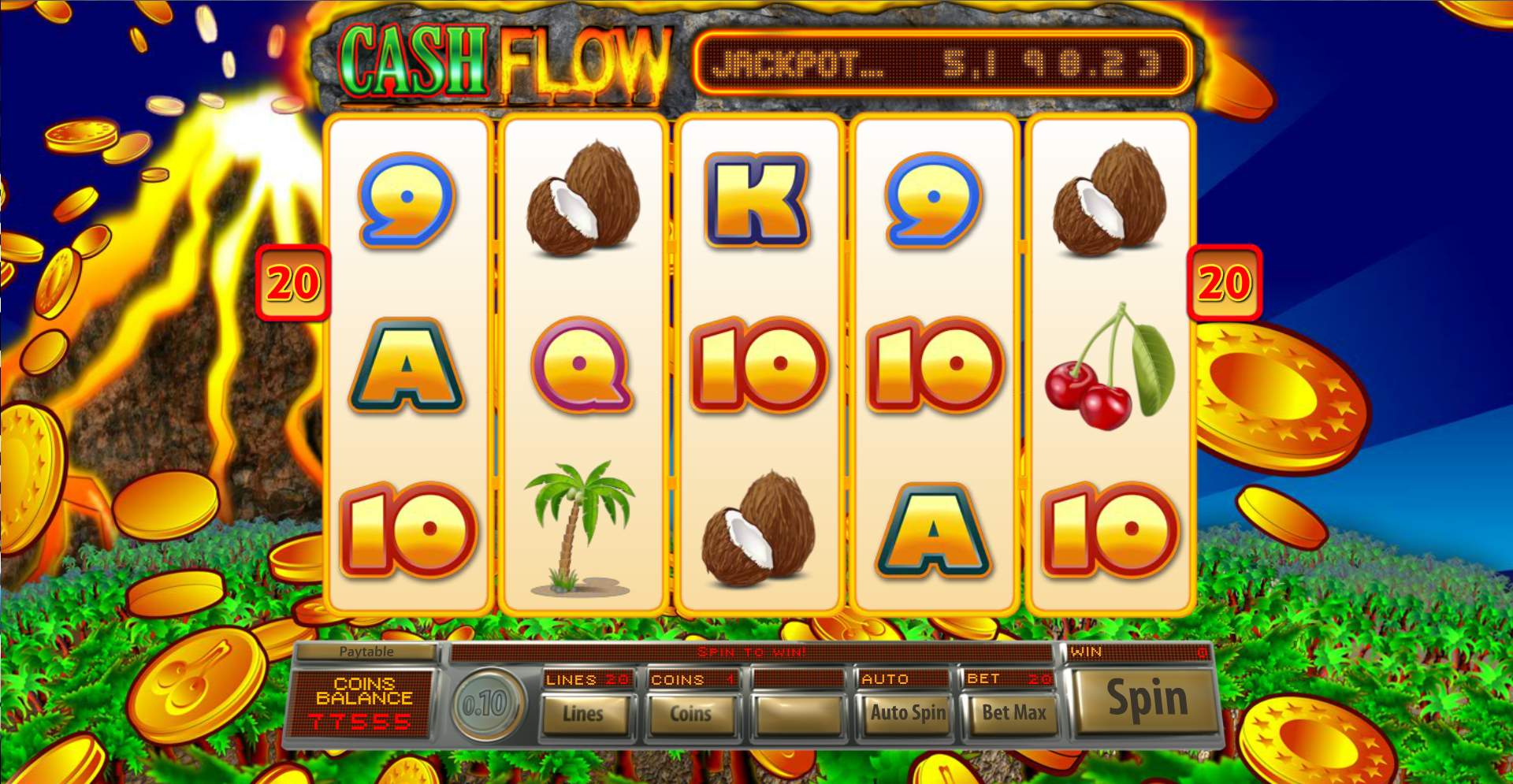
- High-Tier (The Wild/Jackpot): The Cash Flow Volcano is the most critical asset. As a Wild, it optimizes payline completion. More importantly, it is the sole vehicle for the Progressive Jackpot via a 5-symbol combination.
- Mid-Tier (The Scatter/Trigger): The Sevens (777) represent the primary volatility driver. They don't just pay; they alter the game's mathematical state by activating the Free Spins mode.
- Low-Tier (The Multipliers): The Coin symbol functions as a secondary revenue stream, providing Scatter wins that are multiplied by the total stake, independent of payline alignment.
- Base Symbols: The Cherry, Tree, Coconut, and Card Royals (A-9) form the foundation of the base game's frequency, ensuring a steady flow of credits.
The Multiplier Engine: Free Spins Analysis
The Free Spins feature is where the "Cash Flow" earns its name. It is not merely a bonus round; it is a 3x Multiplier Event.
When the Sevens trigger the feature (5, 10, or 15 spins depending on the quantity landed), the game enters a high-yield state where every payline win is tripled. For the strategic player, the value of the Free Spins round is exponentially higher than the base game. The ability to re-trigger this feature during the round means that a lucky streak can lead to a compounding effect of tripled wins, significantly shifting the RTP (Return to Player) in the player's favor during that specific window.
The Progressive Jackpot Ecosystem
From a technical standpoint, the Cash Flow jackpot is a "Dual-Stream Progressive." By linking the jackpot to both the new Video Slot and the original Classic Slot, the developers have created a higher "velocity of accumulation."
For the player, this means:
- Faster Pot Growth: More players contributing across two formats means the jackpot reaches "breakout" levels more quickly.
- Increased Hit Frequency of Large Amounts: You are essentially playing in a larger pool, increasing the psychological and mathematical excitement of the hunt.
Statistical Breakdown & Technical Specs
- Volatility Profile: High (driven by the 3x multiplier and progressive jackpot).
- Payline Logic: Left-to-Right (Standard) / Any Way (Scatters/Free Spins).
- Feature Frequency: High (due to re-triggerable Free Spins).
- Jackpot Mechanism: Dual-Source Progressive.
Technical Data Matrix
| Parameter | Data Point |
|---|---|
| Reel Configuration | 5-Reel Video Format |
| Wild Functionality | Substitution + Jackpot Trigger |
| Scatter Multiplier | Total Stake Multiplier |
| Free Spin Multiplier | 3.0x |
| Free Spin Re-trigger | Yes |
| Jackpot Source | Shared (Classic + Video) |
Strategic Optimization: The High-Stakes Approach
1. Volatility Buffering: Given the high-volatility nature of the 3x multiplier and the jackpot, players should employ a "bankroll cushioning" strategy. This involves setting aside a specific portion of the budget strictly for the "eruption" phases.
2. Maximizing the Multiplier: The goal is to stay in the Free Spins round as long as possible. Because the wins are tripled, the "value per spin" is 300% of the base game. Identifying the Sevens is the priority.
3. Line Optimization: To maximize the probability of triggering the 5x Volcano Wild (the Jackpot), playing the maximum number of active lines is statistically mandatory.
Investor FAQ
Q: What is the most efficient way to trigger the highest win potential?
A: Landing 5 "Cash Flow Volcano" symbols for the jackpot, or landing 5 "Sevens" to secure the maximum 15 Free Spins with the 3x multiplier.
Q: How does the shared jackpot affect my odds?
A: It doesn't change your individual mathematical probability per spin, but it significantly increases the magnitude of the prize you are playing for.
Q: Are Scatters paid differently than paylines?
A: Yes. Paylines are calculated per line, whereas Scatters (Coins/Sevens) are paid as a multiplier of your total staked amount and are added to your payline winnings.
Q: Does the 3x multiplier apply to the jackpot?
A: No, the 3x multiplier applies to payline wins during the Free Spins round. The jackpot is a separate, massive prize triggered by the Volcano Wilds.
Q: Can I play with low stakes and still win the jackpot?
A: Yes, the jackpot is triggered by symbol combination, not by the size of the bet, though higher stakes obviously increase the total payout value.
Conclusion
Cash Flow is a sophisticated blend of classic slot mechanics and modern high-reward features. For the player who values mathematical depth, multiplier potential, and the allure of a rapidly growing progressive jackpot, this game offers an elite gaming experience.
Prepare your capital, master the volatility, and prepare for the eruption. Play Cash Flow now.
Frequently Asked Questions
What is the Cash Flow slot about?
The Cash Flow slot is designed around volatility and offers a progressive jackpot with potential multipliers.
How do multipliers work in Cash Flow?
Multipliers in Cash Flow increase the value of wins, especially during the Free Spins feature.
Can I re-trigger bonuses in Cash Flow?
Yes, bonuses in Cash Flow, particularly Free Spins, can be re-triggered for additional winning opportunities.